Paper wasp colony neutralization stops stinging insects from establishing aerial territories along roof eaves, second-story soffits, and porch fascia across Bexar County. Red paper wasps (*Polistes carolina*) and…
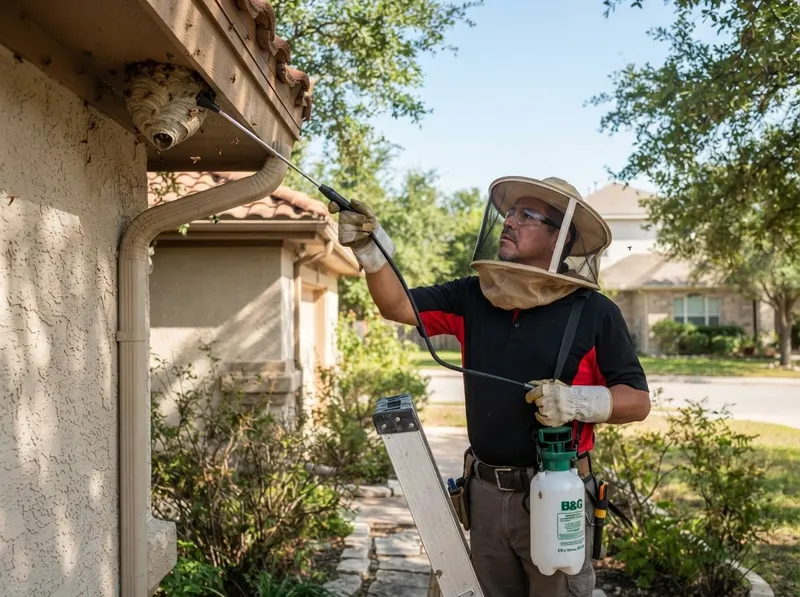
Paper wasp colony neutralization stops stinging insects from establishing aerial territories along roof eaves, second-story soffits, and porch fascia across Bexar County. Red paper wasps (*Polistes carolina*) and yellow paper wasps (*Polistes metricus*) construct umbrella-shaped, open-celled paper nests under overhangs, relying on the high thermal exposure of South Texas summers to accelerate brood development. Left untreated, adult females aggressively defend flight lanes near entry points, patios, and outdoor kitchens. Over-the-counter spray applications frequently trigger defensive swarming because aerosol propellants scatter workers rather than neutralizing the foundational queen or deep reproductive comb. Professional perimeter neutralization deploys direct aerosol knockdown agents, complete mechanical nest detaching, and microencapsulated residual barrier products on mounting surfaces to deter satellite nest construction.
Treatment selection balances localized nest removal against full structural exclusion. When two or three solitary paper wasp combs sit under standard 10-foot eaves, a targeted physical detachment and perimeter residual wash provides immediate control. However, when stinging insects breach attic vents, barrel-tile gaps in roofs around Stone Oak, or historic tongue-and-groove porch ceilings in Monte Vista and King William, the work shifts to sub-fascia insecticidal dusting, void injection, and wire mesh exclusion. Ground-nesting stinging insects, such as southern yellowjackets or cicada killers in the clay soils near Helotes Creek and Culebra Park, require directional liquid injections directly into subterranean burrows rather than surface spraying.
Environmental conditions dictate protocol variations throughout the city. Properties bordering drainage canals along the San Antonio River Walk or heavily vegetated properties in Alamo Heights, Terrell Hills, and The Dominion encounter heightened paper wasp populations drawn to natural water reservoirs and pool basins. High humidity and surface heat above 95°F degrade standard retail insecticides within days; commercial microencapsulated formulations adhere to stucco, limestone, and composite trim for up to 90 days. Treatments prioritize pet-conscious and family-conscious active ingredients that dry clear and remain bonded to target masonry and wood fascia without drifting into living quarters.
Every job gets a firm, written price after a free on-site visit.
Tell us about your stinging insect and paper wasp colony neutralization job in San Antonio and we'll send a clear, written quote, usually the same day.
 BugBoundary Pest Control